September 16, 2026
Download:
U.S. Broadband Industry Investment Reaches $92.6 Billion as Fiber-Fueled Networks Connect the Innovation Economy
3.4% year-over-year increase extends strongest sustained era of network investment on record
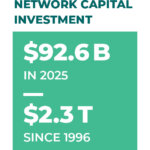
America’s broadband providers invested $92.6 billion in U.S. communications infrastructure in 2025—a 3.4% increase over 2024 and the third-highest annual total since 2002. Cumulative investment now approaches $2.3 trillion since 1996 as consumer and business demand for faster, more sophisticated networks grows.
In 2025, broadband providers pushed fiber deeper into more communities, expanding modern networks to meet demand that is growing in scale and changing in character. Average monthly broadband usage reached 767.4 gigabytes per subscriber by year’s end, up 9.9% from 2024. Looking ahead, Cisco projects that AI and agentic AI adoption could increase consumer-driven network traffic 6.6-fold by 2035.
But traffic volume tells only part of the capital investment story. The directional flow of data is also changing fundamentally. For decades, networks were engineered primarily to deliver information downstream—to stream a movie, load a webpage or download a file. AI, cloud synchronization and backup, as well as video sharing are driving growing volumes of data in the opposite direction: prompts, photographs, video, sensor readings and other inputs move upstream for processing. In 2025 alone, upstream usage rose 21.7%, more than twice the growth rate of overall usage.
Fiber is uniquely suited to this changing traffic pattern because it can deliver the same high-capacity performance upstream and downstream—providing the symmetrical capacity increasingly important to AI and other data-intensive applications.
The defining network investment challenge of the AI era is not simply supporting more traffic, but preparing for traffic that moves and behaves differently.
The benefits of deeper fiber investment extend far beyond customers with a direct fiber connection. 5G, and eventually 6G, networks rely heavily on fiber backhaul. Satellites hand traffic off to fiber-connected ground stations. Fixed wireless and Wi-Fi draw on the capacity of the wired networks behind them. Deeper fiber deployment strengthens the reach and performance of the broader connectivity ecosystem.
Providers invested accordingly in 2025: accelerating fiber deployment, completing C-band and 5G buildouts, expanding fixed wireless access and pursuing converged fiber-and-wireless strategies. Providers also modernized acquired networks and added capacity through densification where data demand is growing fastest.
U.S. BROADBAND INDUSTRY INVESTMENT JOURNEY
Broadband ranks among America’s most capital-intensive industries. Over the past three decades, broadband industry investment has propelled distinct eras of the internet’s growth and evolution:
- 1996–2001: Light-Touch Regulation & Dot-Com Boom – Surging investment after the 1996 Telecom Act.
- 2002–2008: Stabilization, Early Broadband & Mobility Advancement – Restructuring, early adoption of broadband, and rapid wireless expansion.
- 2009–2013: Start of the Streaming Era & Smartphone Surge – Growing demand for streaming video, smartphones and mobile connectivity, contrasting with sluggish general economic investment.
- 2014–2019: Fiber & Wireless Densification – Expansion of fiber, LTE and small cells laid groundwork for next-generation networks.
- 2020–2025: 5G, Fiber & the Rise of AI – Record, sustained investment expanded fiber capacity and 5G reach, strengthening the connectivity that AI and other data-intensive applications depend on.
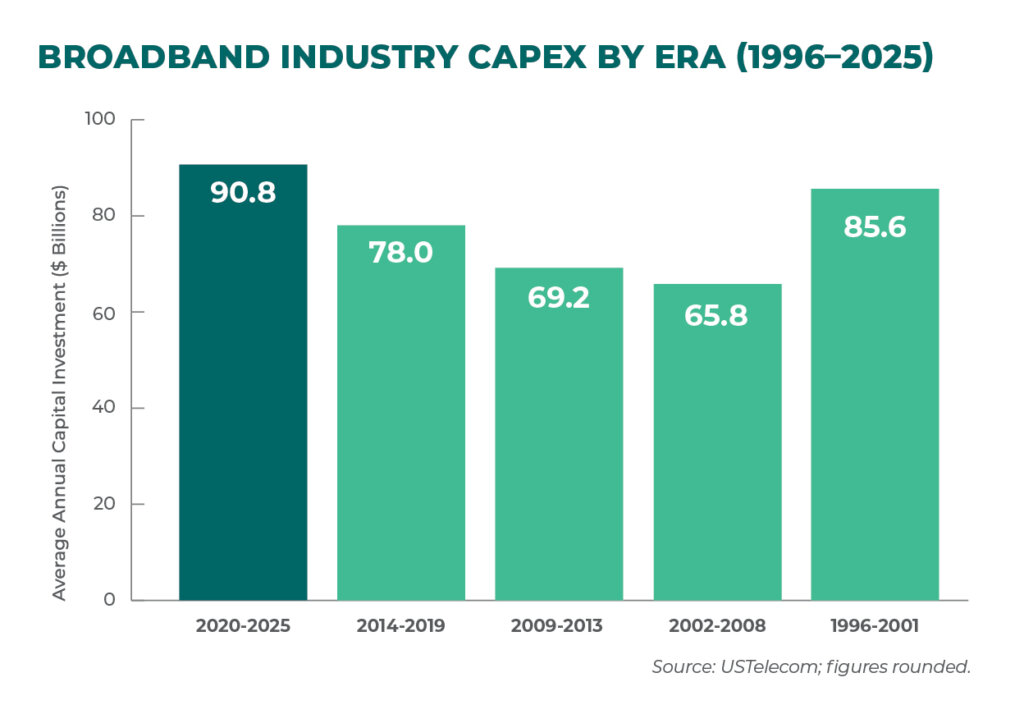
Averaging $90.8B per year, 2020–2025 is the highest sustained era of investment on record. This sustained commitment of private capital is meeting the rising demands of U.S. consumers and businesses, while building the essential connectivity foundation for AI and other advances.
THE BOTTOM LINE
In 2025, providers extended an era of historically high broadband industry investment—expanding rural reach, modernizing wireless networks, adding capacity, and pushing fiber deeper into communities. At its core, this investment reflects broadband providers’ sustained commitment to ensuring that the opportunities created by American innovation reach every community.
METHODOLOGY
This USTelecom report collects capital expenditures data for major wireline, wireless, and cable broadband providers to approximate an industry aggregate. It does not include smaller wireline broadband providers, electric cooperatives, or satellite broadband providers, whose data are difficult to obtain on a consistent and comparable basis. Because these competitors are excluded, the $92.6 billion reported here is a conservative estimate.
Sources
Household broadband usage and upstream growth: OpenVault Broadband Insights, Q4 2025. AI network-traffic projection: Cisco, AI Impact on Wide Area Networks, 2026.